
Introduction
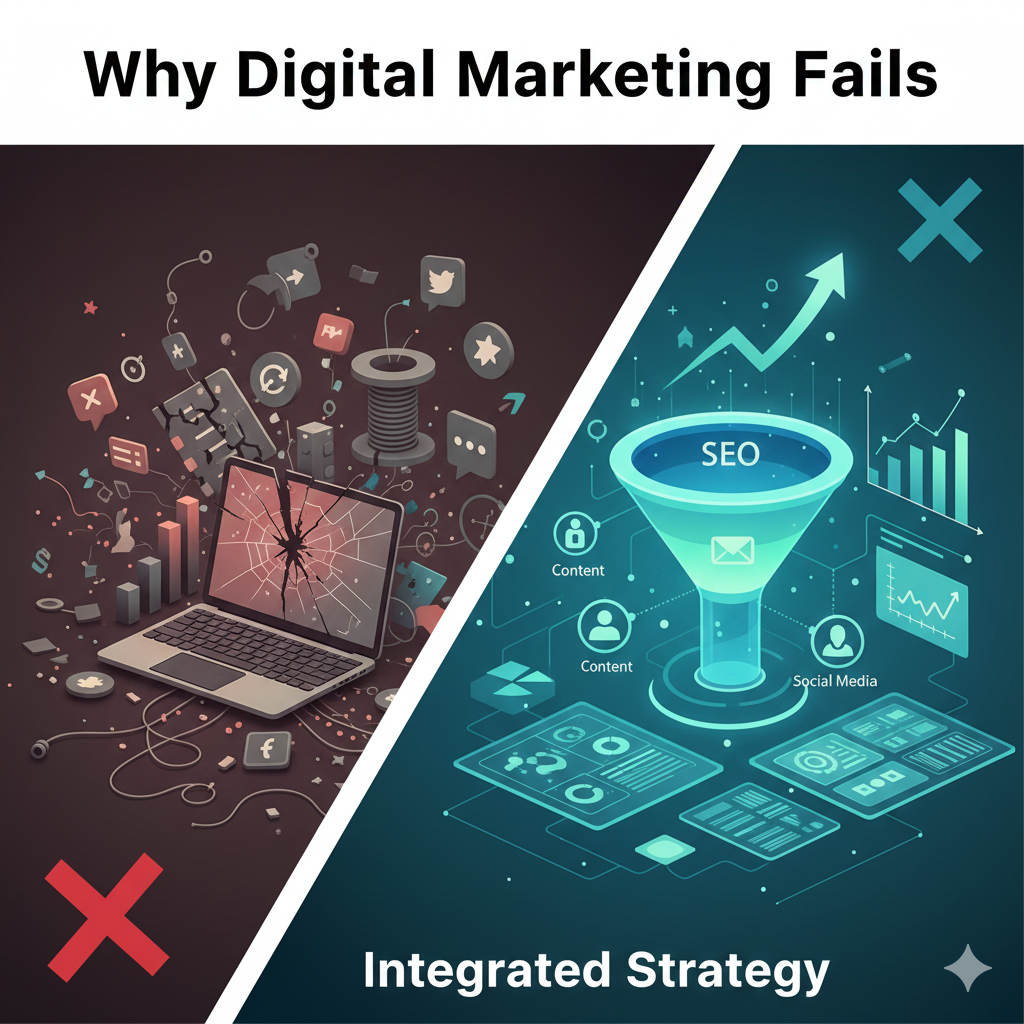
Many businesses invest heavily in digital marketing yet struggle to see real results. Websites get traffic but no leads. Ads run, budgets burn, and conversions remain low. Social media looks active, but sales do not follow.
This is not because digital marketing doesn’t work.
Businesses fail online because they lack an end-to-end digital marketing strategy.
Without a unified approach, digital efforts become fragmented, inefficient, and impossible to scale. This article explains why businesses fail online, how digital marketing breaks down without strategy, and how an end-to-end digital marketing approach prevents failure and drives growth.
What Is an End-to-End Digital Marketing Strategy?
An end-to-end digital marketing strategy is a complete, connected growth framework that manages the entire customer journey—from first brand interaction to conversion and long-term retention.
It aligns:
-
Business goals
-
Digital channels
-
Customer behavior
-
Content
-
Technology
-
Data and analytics
Instead of isolated activities, everything works together toward measurable business growth.
The Reality: Why Most Businesses Fail Online
1. Fragmented Digital Efforts
Many businesses use multiple vendors or internal teams for:
-
SEO
-
Paid ads
-
Social media
-
Website management
Each works independently with no shared strategy.
Result:
-
Conflicting messaging
-
Disconnected campaigns
-
No clear growth direction
Fragmentation is one of the biggest causes of digital marketing failure.
2. No Clear Digital Planning
Businesses often start digital marketing without answering basic questions:
-
Who is the target audience?
-
What problem are we solving?
-
What action should users take?
-
How will success be measured?
Without digital planning, marketing becomes guesswork.
3. Traffic Without Conversion Strategy
Many businesses focus only on:
-
Website visits
-
Impressions
-
Followers
But traffic alone does not equal growth.
Without:
-
Optimized landing pages
-
Clear CTAs
-
Lead funnels
-
Follow-up systems
Visitors leave without converting, leading to false growth signals.
4. Ads Without a Growth Funnel
Paid advertising is one of the fastest ways to lose money without strategy.
Common mistakes:
-
Running ads without optimized landing pages
-
No retargeting strategy
-
No conversion tracking
-
No lead nurturing
This leads to high spend and low ROI—one of the most common digital marketing failures.
5. SEO Without Business Alignment
SEO is often treated as a technical task instead of a business tool.
Problems include:
-
Ranking for irrelevant keywords
-
Content without buyer intent
-
No internal funnel alignment
-
No conversion optimization
SEO without strategy creates visibility without value.
6. Content Without Purpose
Many brands create content just to “stay active.”
Without:
-
Audience intent mapping
-
Funnel-based content
-
SEO integration
-
Performance tracking
Content fails to educate, convert, or build authority.
7. No Data-Driven Decision Making
Businesses fail online when decisions are based on assumptions instead of data.
Without:
-
Analytics setup
-
Conversion tracking
-
Funnel monitoring
-
ROI measurement
There is no way to know what works and what doesn’t.
8. Lack of Automation and Follow-Ups
Leads are often lost due to:
-
No CRM
-
No email or WhatsApp automation
-
No follow-up system
Even good campaigns fail without backend systems to convert interest into revenue.
How Digital Marketing Failure Impacts Online Business Growth
When digital marketing lacks an end-to-end strategy, businesses face:
-
Wasted budgets
-
Inconsistent branding
-
Poor lead quality
-
Low trust
-
Slow or stagnant growth
Online business growth becomes unpredictable and unsustainable.
How an End-to-End Digital Marketing Strategy Solves These Problems
1. Unified Growth Vision
An end-to-end strategy aligns every activity with clear business objectives:
Why Businesses Need a Full-Service, End-to-End Approach
A fragmented vendor model creates gaps. A full-service digital marketing approach ensures:
Who Needs an End-to-End Digital Marketing Strategy?
-
Lead generation
-
Sales growth
-
Brand authority
-
Customer retention
2. Customer Journey Mapping
The strategy covers every stage:
-
Awareness
-
Consideration
-
Conversion
-
Retention
No customer touchpoint is ignored.
3. Integrated Channel Execution
SEO, ads, content, social media, and automation work together instead of competing. -
This increases:
-
Conversion rates
-
Brand consistency
-
ROI
4. Funnel-Driven Marketing
Every campaign is connected to: -
Landing pages
-
Lead magnets
-
This turns traffic into leads and leads into customers.
4. Funnel-Driven MarketingEvery campaign is connected to:
-
Landing pages
-
Lead magnets
-
This turns traffic into leads and leads into customers.
5. Data-Backed Optimization
Performance is continuously improved using:
-
Analytics
-
A/B testing
-
Marketing becomes predictable and scalable.
-
Funnel tracking
-
ROI analysis
-
One strategy
-
One accountability system
-
This is essential for modern online business growth.
-
One growth roadmap
-
Startups struggling to scale
-
SMEs wasting ad budgets
-
If digital results feel inconsistent, the strategy is missing.
-
Brands with low online conversions
-
Businesses entering competitive markets
-
Companies aiming for sustainable growth
Explore integrated, end-to-end digital marketing solutions:
🌐 https://360marketers.in/Learn how structured digital planning drives sustainable online growth:
🌐 https://www.adfusionmedia.com
Conclusion
Businesses don’t fail online because digital marketing doesn’t work.
They fail because digital marketing without an end-to-end strategy is broken.An integrated digital marketing strategy connects vision, execution, technology, and data—turning online presence into real business growth.
Without it, digital efforts remain expenses.
With it, they become growth engines.