
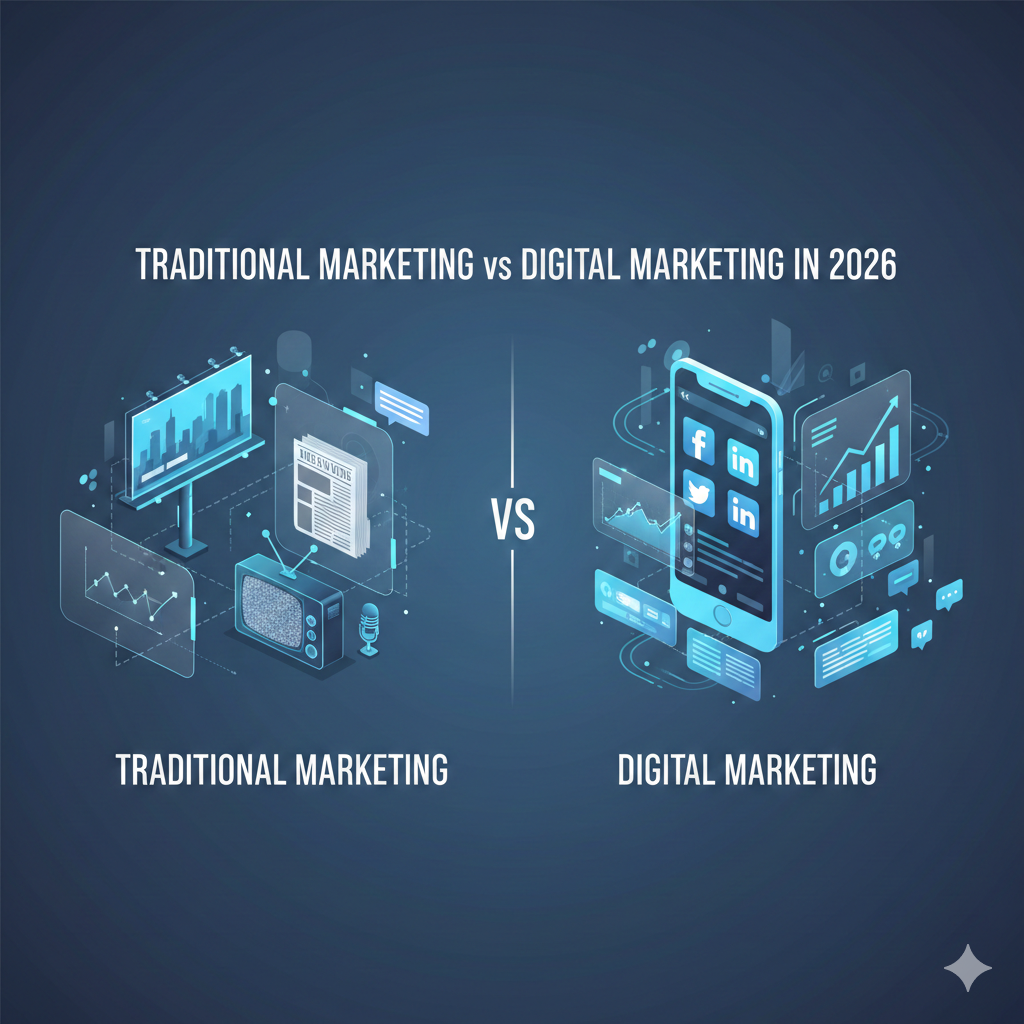
Introduction: Why This Debate Matters More in 2026 Than Ever
“Should we invest more in traditional marketing or digital marketing?”
In 2026, this is no longer a simple question — and the wrong answer can cost brands visibility, relevance, and growth.
Markets have evolved. Consumer behavior has shifted. Technology has reshaped attention spans. Yet many businesses are still operating with outdated marketing mindsets.
To grow in 2026, brands must clearly understand what works, what doesn’t, and why.
Understanding Traditional Marketing
What Is Traditional Marketing?
Traditional marketing refers to offline promotional methods that have existed for decades, including:
-
Print advertisements (newspapers, magazines)
-
Television commercials
-
Radio ads
-
Billboards and hoardings
-
Flyers, brochures, banners
-
Event sponsorships
These methods dominated brand communication long before the digital era.
Strengths of Traditional Marketing
Traditional marketing still has value — when used correctly.
✔ Strong local visibility
✔ High brand recall in specific geographies
✔ Effective for mass awareness
✔ Builds credibility among non-digital audiences
For certain industries, traditional channels still play a role.
Limitations of Traditional Marketing in 2026
However, in 2026, traditional marketing alone faces serious limitations:
❌ No real-time performance tracking
❌ One-way communication
❌ High cost with uncertain ROI
❌ Limited audience targeting
❌ No personalization
❌ Slow campaign optimization
Brands are essentially broadcasting, not engaging.
Understanding Digital Marketing
What Is Digital Marketing?
Digital marketing includes online, data-driven marketing activities, such as:
-
Search engine optimization (SEO)
-
Social media marketing
-
Paid online advertising
-
Content marketing
-
Email & WhatsApp marketing
-
Influencer marketing
-
Marketing automation
It is the backbone of modern marketing.
Digital Marketing Benefits That Define 2026
Digital marketing is not just popular — it’s necessary.
🔹 1. Precise Targeting
Brands can target users by:
-
Location
-
Interests
-
Behavior
-
Purchase intent
-
Demographics
This makes every campaign more efficient.
🔹 2. Measurable Performance
Every click, impression, lead, and conversion can be tracked.
Brands know:
-
What works
-
What doesn’t
-
Where to optimize
This data-driven approach is a game-changer.
🔹 3. Cost Efficiency
Compared to traditional marketing, digital campaigns:
-
Require lower entry budgets
-
Deliver scalable results
-
Offer better ROI
Small brands can compete with big players.
🔹 4. Two-Way Engagement
Digital marketing enables:
-
Comments
-
Shares
-
Conversations
-
Community building
Brands don’t just talk — they interact.
5. Personalization at Scale
In 2026, personalization is expected.
Digital marketing allows brands to:
-
Customize messages
-
Retarget interested users
-
Build long-term relationships
Traditional marketing simply cannot match this.
Traditional vs Digital Marketing: A Direct Comparison
| Aspect | Traditional Marketing | Digital Marketing |
|---|---|---|
| Audience Reach | Broad, untargeted | Highly targeted |
| Cost | High | Flexible & scalable |
| Tracking | Limited | Real-time analytics |
| Engagement | One-way | Two-way |
| Speed | Slow | Instant |
| Optimization | Difficult | Continuous |
| Personalization | Not possible | Advanced |
The contrast becomes even clearer in 2026.
What Actually Works in 2026?
Here’s the truth most agencies won’t tell you:
👉 It’s not traditional OR digital. It’s strategic integration.
The Role of Modern Marketing in 2026
Modern marketing focuses on:
-
Customer journeys, not channels
-
Experiences, not advertisements
-
Data, not assumptions
In 2026, successful brands use:
-
Digital marketing as the core growth engine
-
Traditional marketing as a supporting visibility layer
Where Traditional Marketing Still Makes Sense
Traditional marketing still works when:
-
Targeting hyper-local audiences
-
Supporting brand credibility
-
But on its own, it is no longer sufficient.
Why Digital Marketing Leads Growth in 2026
Digital marketing dominates because:
-
Consumers spend more time online
-
Buying decisions start with search
-
Brands that ignore digital marketing are invisible to modern consumers.
The Smart Approach: Integrated Marketing Strategy
The real winners in 2026 use:
-
Digital marketing for targeting, performance & conversions
-
Traditional marketing for visibility & recall
-
This creates brand consistency, trust, and scale.
How Ad Fusion Media Helps Brands Win in 2026
Ad Fusion Media believes marketing is not about choosing sides — it’s about building systems.
As an integrated media ecosystem, Ad Fusion Media:
-
Aligns traditional and digital marketing
-
Designs modern marketing strategies
-
👉 Explore future-ready marketing solutions at:
https://adfusionmedia.com
Conclusion: The Future Belongs to Adaptive Brands
In 2026, the question is not:
“Traditional marketing or digital marketing?”The real question is:
“Is your marketing strategy built for how people actually behave today?”Brands that adapt win.
Brands that resist fade.Digital marketing leads the future — and integrated strategies dominate it.